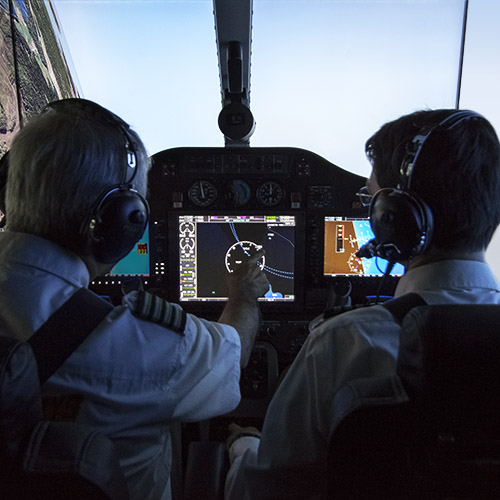
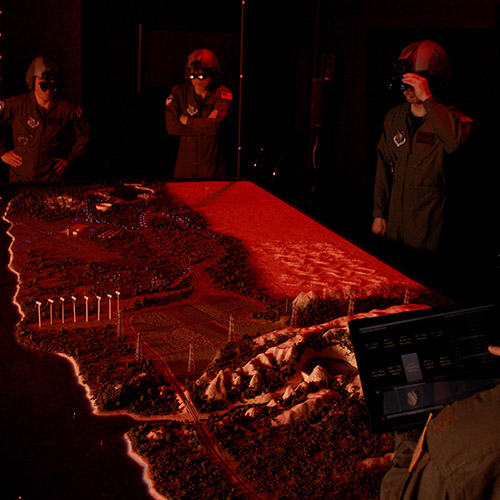
Southampton, PA, USA. November 9, 2011 – The NASTAR® Center, the premier commercial aerospace training and research center, in conjunction with SwRI and the David Clark Company, conducted evaluations of a new generation pressure suit for commercial suborbital flights. The testing will help advance human health, protection, performance, and training of crew and passengers embarking on upcoming commercial space flights.
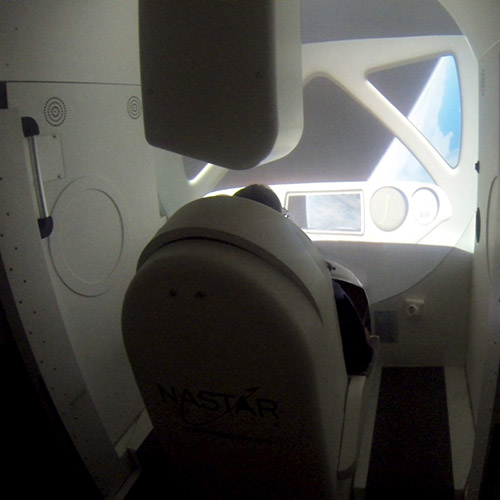
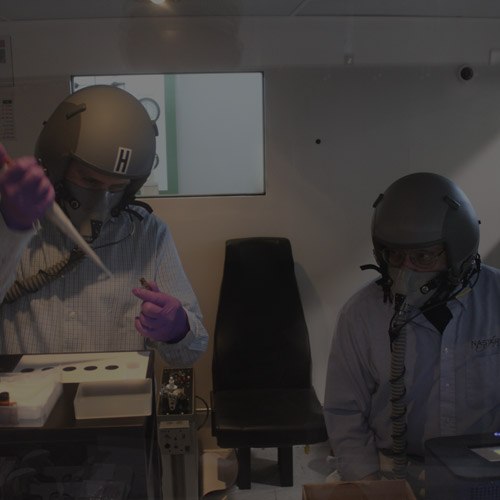
Two SwRI researchers and suborbital flight ticket holders, Drs. S. Alan Stern and Dan Durda, visited the National AeroSpace Training And Research (NASTAR) Center outside Philadelphia on November 2, 2011 where they completed another milestone in suborbital research. Stern and Durda evaluated a David Clark Company’s Contingency Hypobaric Astronaut Protective Suit (CHAPS) pressure suit under G during a series of centrifuge runs in the NASTAR “Phoenix” STS-400 high performance human centrifuge. The CHAPS represents the latest generation of aerospace crew protective equipment for the commercial spaceflight market.
Stern and Durda completed 20 NASTAR centrifuge runs both in and out of the CHAPS suits, exposing them to both head-to-foot and thru-the-chest accelerations up to 6-Gs, typical of what space travelers could experience during suborbital flights. Suit evaluation areas included: suit fit, mobility, range of motion, comfort, field-of view, communications, suit to vehicle interface, and ability to perform basic tasks under G.
To date, no other space company or research organization has assessed a pressure suit for commercial suborbital flights in a centrifuge.
“We’re breaking new ground with this type of suit evaluation —it’s more realistic and higher intensity than any suborbital launch exercise taken previously by any person or company in the world to date ” says SwRI Principal Investigator Stern.
Added SwRI Co-Investigator Durda, “We are the first future space flyers to wear the David Clark CHAPS suit in centrifuge runs. We also provided detailed engineering feedback evaluations of the suit following the launch simulations.”
Daniel M. Barry, Vice President and Director of Research and Development for David Clark Company, acknowledged the significance of the test as it relates to aerospace crew protective equipment design. “Historically, the complexity of pressure suit systems was driven by the need to address a wide range of requirements associate to traditional government/military programs. The CHAPS was developed to address the specific requirements unique to commercial spaceflight operations. It provides fundamental contingency hypobaric protection and incorporates advanced materials to allow for a lightweight, comfortable and highly functional pressure suit system.”
“This test provided a deeper understanding of issues facing crew health and protection on commercial spaceflights” said Brienna Henwood, Director of Space Training and Research at NASTAR Center. “We will be integrating the expertise and lessons learned into upcoming programs to provide our clients with the best, most realistic training available.”
Presentations describing the goals, experiences, and results of the suited high-G runs are planned to be given by SwRI, NASTAR Center, and David Clark Company at the 2012 Next-Generation Suborbital Researchers Conference (NRSC-2012) in Palo Alto, California from February 27-29, 2012. For more information about NSRC-2012 go to http://nsrc.swri.org, or contact Constantine Tsang, (720) 208-7202 (con@boulder.swri.edu).
For more information about SwRI’s suborbital program and flight crew training, contact Alan Stern, (303) 324-5269 or astern@boulder.swri.edu, or Dan Durda, (303)546-9670 or durda@boulder.swri.edu.
###
About David Clark Company
David Clark Company Incorporated (DCCI) of Worcester MA has pioneered air and space crew protective equipment design, development, and manufacture since 1941 with products ranging from anti-G suits to pressure/space suits. DCCI has provided equipment for virtually all of the USAF and NASA high altitude and space programs including the D-558-2, X-15, XB-70, YF-12A, SR-71 Blackbird, WB-57F, U-2, ER-2, Lifting bodies, Gemini, Apollo, and Space Shuttle. For more information please visit: www.davidclark.com.
About NASTAR Center
The National AeroSpace Training And Research (NASTAR®) Center is a wholly-owned subsidiary of Environmental Tectonics Corporation (ETC®) (www.etcusa.com). The NASTAR Center is a state-of-the-art aerospace training, research, and educational facility dedicated in improving the health and safety of humans in extreme conditions. NASTAR Center serves military aviation (fixed and rotary wing), civil aviation (fixed and rotary wing), space travel (government and private) and provides research support for component and human factors testing. www.nastarcenter.com
About ETC:
ETC (OTC Bulletin Board: ETCC:PK) designs, manufactures and sells software driven products and services used to recreate and monitor the physiological effects of motion on humans and equipment and to control, modify, simulate and measure environmental conditions. These products include aircrew training systems (aeromedical, tactical combat and general), disaster management systems, sterilizers (steam and gas), environmental testing products and hyperbaric chambers and other products and services that involve similar manufacturing techniques and engineering technologies. ETC’s unique ability to offer complete systems, designed and produced to high technical standards, sets it apart from its competition. ETC is headquartered in Southampton, PA. For more information about ETC, visit http://www.etcusa.com or contact CFO Bob Laurent at Tel: 215-355-9100 ext. 1550 or email blaurent@etcusa.com.
Forward-looking Statements:
This press release contains forward-looking statements, which are based on management’s current expectations and are subject to uncertainties and changes in circumstances. Words and expressions reflecting something other than historical fact are intended to identify forward-looking statements, but are not the exclusive means of identifying such statements. The Company’s actual results could differ materially from those anticipated in forward-looking statements as a result of a variety of factors, including those discussed in “Risk Factors” included in the Company’s most-recent Annual Report on Form 10-K filed with the United States Securities and Exchange Commission. We caution you not to place undue reliance on these forward-looking statements.