SOUTHAMPTON, Pa., July 25,2011 — The NASTAR® Center, the premier commercial aerospace training and research center in the world, completed the first dedicated NASTAR Suborbital Scientist Training Program for the Atsa Suborbital Observatory project, with eight team members from the Planetary Science Institute (PSI), The Citadel, and other South Carolina colleges.
The Atsa project will use a reusable suborbital spacecraft equipped with a specially designed telescope to provide low-cost space-based observations above the contaminating atmosphere of Earth, while avoiding some operational constraints of satellite telescope systems.
This was the first dedicated NASTAR Suborbital Scientist training program of its kind focused on a single project. “NASTAR is providing essential input for designing the training regimen we will require for Atsa operators,” said Faith Vilas, PSI Senior Scientist and Atsa Project Scientist.
“Because this is a human-tended observatory, we need to understand in more than a theoretical way how the operator will be affected by the launch environment,” said Luke Sollitt, Atsa Deputy Project Scientist and an Assistant Professor at The Citadel. “This will also impact the design of the interfaces and the instrument itself.”
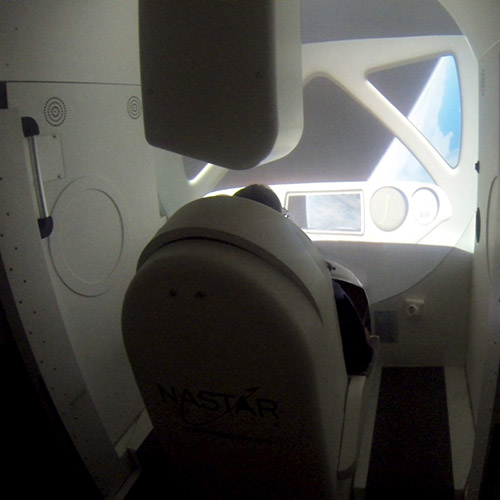
The three-day NASTAR Suborbital Scientist course equips individuals with hands-on knowledge and skills to safely cope with the rigors of suborbital spaceflight and gives an understanding of the challenges involved with conducting experiments in space. The course includes four core elements: Altitude Physiology, G-Tolerance, Space Launch and Reentry Training, and Distraction Management.
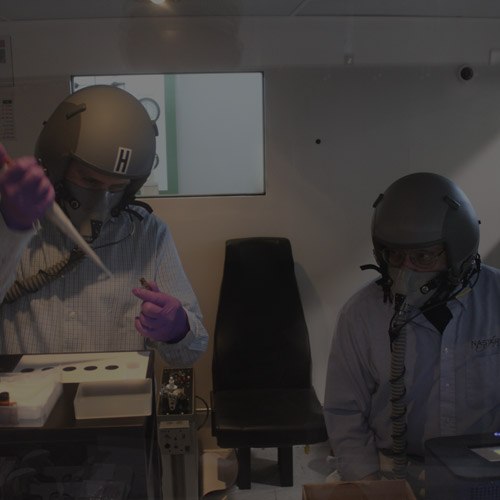
High-altitude physiology training enables trainees to experience the effects of hypoxia or oxygen-deprivation firsthand with an altitude chamber flight to 25,000 feet. Trainees also learn safety protocols and considerations in a loss of cabin pressure event.